
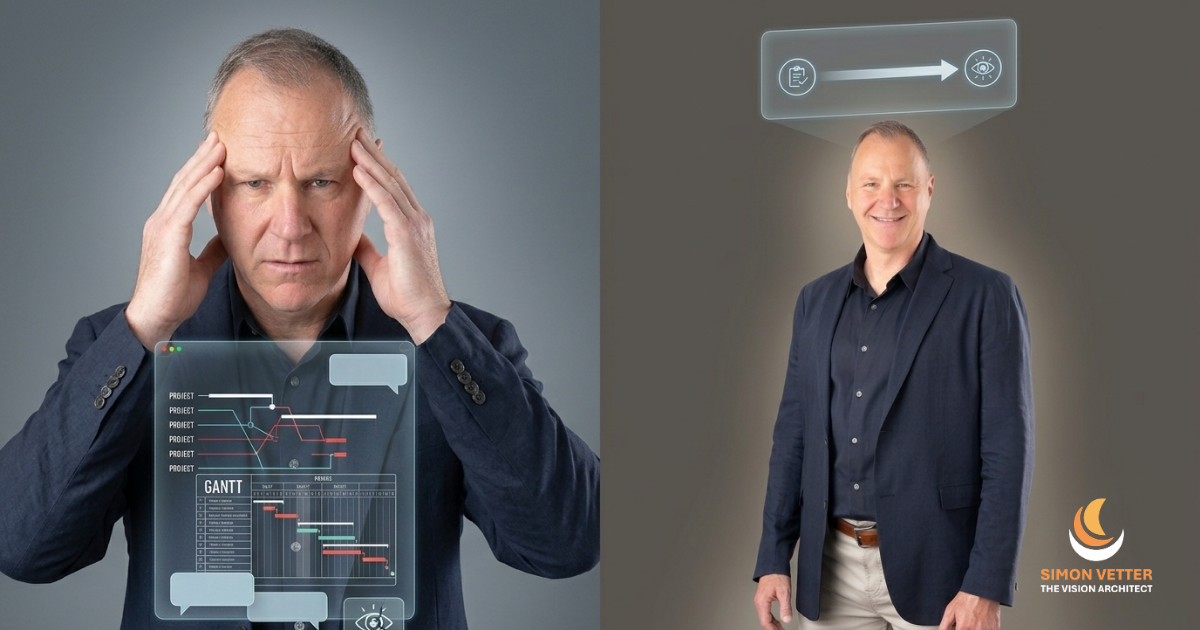
There’s a quiet crisis unfolding in organizations at every level.
It’s not a strategy problem. It’s not a talent problem. It’s not even a resource problem.
It is a presence problem.
The leaders who are most needed, the CEOs, senior executives, and leadership teams responsible for direction, culture, and performance are often the ones most trapped in reactive mode. Overloaded calendars. Endless decisions. The constant pull of urgency over importance.
And somewhere in the noise, the most essential quality of great leadership quietly disappears.
In Episode 209 of The Vision Architect Podcast, I sat down with executive coach and bestselling author Scott Eblin for a conversation that challenged me to rethink what leadership performance actually requires. His conclusion is clear: the single most powerful lever available to overwhelmed leaders is not a new strategy. It’s presence, practiced with intention, every single day.
The Central Insight: Mindfulness Is Not What You Think It Is
Most leaders I work with resist the word mindfulness. It sounds soft. Impractical. Disconnected from the boardroom realities they navigate every day.
Scott reframes it in one sentence: mindfulness equals awareness plus intention.
Awareness of what’s happening around you and inside you. Intention about what to do or not do next.
That is not a soft skill. That is precision. And it’s one of the highest-leverage capabilities a senior leader can develop because the gap between stimulus and response is where judgment either holds or collapses.
Three Practical Leadership Lessons from This Episode
- Prepare yourself, not just your content – Before every important meeting, most leaders spend 100% of their preparation time on the agenda, the data, and the talking points. Zero on presence. Scott’s practice: ask two questions before every significant interaction. What outcome am I trying to create? And how do I need to show up to make that outcome more likely? These two questions take 90 seconds. They shift a leader from reactive to intentional and they change how every word you say is received.
- To scale up, leaders need to let go – Scott identifies what he calls the Go-To Person Trap: the identity that gets leaders promoted being the expert, the solver, the person with all the answers is the same identity that eventually caps their impact. The most counterintuitive move for a senior leader is not to hold more. It’s to release more. To shift from being the go-to person to building a team of go-to people. That shift is not cognitive. It’s emotional. And the underlying emotion, Scott says, is fear. The leaders who make this shift don’t just multiply their impact. They build the kind of organization that works brilliantly even when they are not in every room.
- Your state shapes your culture – Scott makes a point that lands harder the longer you sit with it: what you think determines how you feel, and how you feel determines how you lead. A leader in chronic fight-or-flight mode doesn’t just underperform individually. They broadcast that state outward into meetings, into decisions, into the culture itself. The practice of managing your state through breathing, intentional routines, and daily self-awareness is not personal development. It’s organizational strategy.
The Connection to Visionary Leadership
Vision without presence is just aspiration. I’ve spent 25 years helping leaders create compelling futures and the ones who move people, build belief, and drive lasting change are not always the most strategically brilliant.
They are the most present.
They show up with intention. They lead from clarity rather than reaction. They create the conditions in every room, every conversation, every decision for people to believe that the future is worth pursuing.
Closing Reflection
The question I keep returning to after this conversation is this:
What would change in your leadership and in your team if you showed up 10% more intentionally every day?
Listen to Episode 209 of The Vision Architect Podcast with Scott Eblin at simonvetter.com/podcast.
